

22 Oct Stainless Steel Kitchen Sinks: Grades, Gauges & Top Brands
How to Choose the Right Sink for Your Project
For a residential construction project, a kitchen sink may represent a relatively small portion of the overall procurement budget. But when you are purchasing hundreds or even thousands of sinks, the specification can have a significant impact on project quality, installation, maintenance, replacement costs, and homeowner satisfaction.
For purchase managers, the challenge is not simply finding the lowest-priced sink. It is finding a product that delivers consistent quality, meets applicable standards, performs reliably, and offers good lifecycle value across the project.
The most important factors to evaluate are stainless-steel grade, material thickness, construction quality, dimensions, mounting style, drainage, sound reduction, certification, and supplier consistency.
Don’t Miss: 5 Kitchen Faucet Features That Actually Make a Difference
1. Start With the Stainless-Steel Grade
The grade of stainless steel is one of the most important—and most frequently overlooked—specifications when comparing kitchen sinks.
Two sinks may look almost identical but can differ significantly in the quality of steel used to manufacture them.
Grade 304: The Preferred Choice for Residential Projects
304 stainless steel offers an excellent balance of corrosion resistance, durability, hygiene, and long-term performance.
It is particularly well suited to residential kitchens, where sinks are exposed to: water and moisture, food residue, hot cookware, heavy utensils, cleaning products, frequent daily use
For residential developments where durability and long-term performance matter, 304-grade stainless steel should be the preferred specification.
What About Grade 202?
Grade 202 is often offered as a lower-cost alternative. For purchase managers, however, price should not be the only consideration.
For domestic-purpose sinks covered by IS 13983, BIS requirements and the applicable certification framework need to be considered before specifying or purchasing a product. Current BIS documentation identifies 304-grade material in testing under the standard, and IS 13983 is included in the compulsory BIS certification framework.
Therefore, 202-grade sinks should not be treated as an acceptable substitute for a compliant 304-grade residential sink simply to reduce procurement cost.
When evaluating suppliers, ask for documentation confirming the actual stainless-steel grade and BIS compliance, rather than relying only on product descriptions or verbal assurances.
Grade 316: For More Demanding Environments
316 stainless steel contains molybdenum and provides enhanced resistance to chloride-related corrosion.
It can be considered for projects in coastal or particularly demanding environments, where additional corrosion resistance may justify the higher cost.
For most residential developments, however, 304 provides the appropriate balance of performance and value.
2. Don’t Judge Quality by Price or Appearance
One of the biggest procurement mistakes is comparing sinks primarily on price.
A cheaper sink may achieve its lower price through differences in steel grade, sheet thickness, overall material weight, reinforcement, welding quality, soundproofing, finish, accessories, quality-control processes
Two sinks with the same dimensions can therefore have very different levels of durability.
Weight Matters—but It Is Not the Only Measure
A heavier sink can indicate that more material has been used, but weight alone should not be used as proof of quality.
When comparing suppliers, evaluate the complete specification:
Steel grade + sheet thickness + dimensions + construction + weight + certification.
If two apparently identical sinks have substantially different weights, ask the supplier why. A significant difference may indicate differences in material thickness or construction.
For large residential projects, these small specification differences can become significant when multiplied across hundreds of units.
3. Check the Steel Thickness
Material thickness directly affects a sink’s resistance to dents, impact, bending, vibration, long-term wear
BIS requirements for stainless-steel sinks include specifications relating to sheet thickness and construction under IS 13983.
For procurement purposes, do not simply accept a specification such as “heavy gauge” or “premium thickness.”
Ask for the actual thickness specification and confirm whether it refers to the sheet before forming or the finished sink.
This distinction is important because forming can affect the final thickness of different areas of a sink.
4. Verify BIS Compliance
For a residential construction project in India, compliance should be part of the procurement checklist—not an afterthought.
IS 13983 covers stainless steel sinks for domestic purposes, including requirements relating to material, dimensions, construction, workmanship, finish, and marking.
BIS documentation also provides for testing and certification of sinks manufactured under the standard, with production conformity and marking requirements.
Before placing a large order, ask the supplier for:
- Valid BIS certification applicable to the product
- Standard Mark/ISI marking where applicable
- Confirmation of stainless-steel grade
- Material test documentation where required
- Thickness specification
- Product drawings and dimensions
- Sample approval before bulk production
Do not rely solely on a supplier’s catalogue stating “304 stainless steel.” Verify the specification.
5. Choose the Right Sink Configuration
Once the material specification is established, select the configuration based on the kitchen layout and expected use.
Single Bowl
A single-bowl sink provides a larger uninterrupted washing area and is useful for kitchens where homeowners regularly handle large vessels, kadhais, pressure cookers, and serving dishes.
Double Bowl
Double-bowl sinks allow users to wash and rinse simultaneously and can be useful in larger kitchens.
One and half Bowl
An offset configuration combines a larger primary bowl with a smaller secondary bowl, providing flexibility without requiring two equally sized bowls.
Workstation Sinks
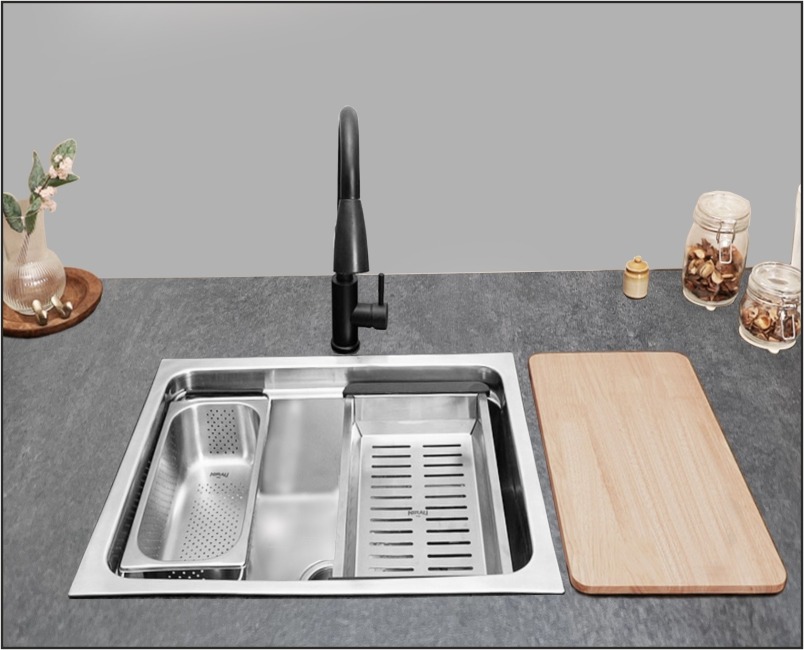
Workstation sinks incorporate accessories such as cutting boards, colanders, and drying racks.
They can add functionality to premium residential kitchens but should be specified only where the project positioning and kitchen design justify the additional cost.
6. Select the Correct Mounting Style
The mounting method affects both installation and the final appearance of the countertop. The right choice should be made at the design stage and confirmed before bulk procurement.
Set-On
Set-On was the traditional installation style and was widely used with conventional granite kitchen platforms. The sink sits on top of the countertop, with the rim visible.
While still used in some projects, it has become less common in contemporary modular kitchens, where cleaner, more integrated installation styles are generally preferred.
Inset
The sink is installed into a prepared countertop cut-out, creating a neat and integrated appearance. Inset installation is widely used in modern modular kitchens and is often preferred for contemporary residential developments.
Plain – The most popular
A plain sink has a flat rim or border positioned between the kitchen platform and countertop slab. It remains a practical option for conventional granite countertop installations.
Before bulk procurement, ensure the sink dimensions, cut-out dimensions, cabinet size, and mounting method are compatible. A small dimensional mismatch can create installation problems across an entire project.
7. Don’t Overlook Sound Reduction
Stainless steel sinks can produce noise and vibration when water, cutlery, or cookware comes into contact with the bowl.
Look for products incorporating sound-absorbing pads, protective undercoating
This can be particularly valuable in modern open-plan kitchens, where sink noise can travel directly into living and dining areas.
For premium projects, sound reduction can be a relatively small additional investment with a noticeable impact on the user experience.
8. Size and Depth Should Match the Kitchen
Before ordering, confirm the available cabinet width, countertop depth, and cut-out dimensions.
Sink depth also matters.
A depth of approximately 7–10 inches works well for many Indian kitchens, although the appropriate depth depends on the kitchen design and expected usage.
Deeper bowls are particularly useful for large cooking vessels, while shallower bowls may be easier for some users to access and clean.
For large projects, always approve a physical sample before finalizing the bulk order.
9. Evaluate the Supplier, Not Just the Product
For a single home, replacing a sink is inconvenient.
For a multi-building project, inconsistent supply or inconsistent quality can become a major operational issue.
Before appointing a supplier, evaluate:
- Manufacturing capability
- Quality-control procedures
- BIS certification
- Material sourcing
- Production consistency
- Ability to meet project quantities
- Lead times
- Packaging and transportation
- Replacement policy
- After-sales support
For large orders, specify the product clearly in the purchase order so the supplier cannot substitute a lower-grade or lighter specification later.
The approved sample should become the benchmark for the entire production batch.
10. Look at Lifecycle Value, Not Just Purchase Price
The cheapest sink is not necessarily the most economical sink.
A lower-priced product may save money during procurement but create additional costs through:
- Installation problems
- Denting or deformation
- Corrosion
- Replacement
- Homeowner complaints
- Warranty claims
- Project punch-list issues
A properly specified 304-grade sink with appropriate thickness and construction may have a higher initial cost but can provide better long-term value.
For purchase managers, the better question is:
“What is the lowest total cost for the required level of quality?”
—not simply:
“What is the lowest purchase price?”
A Practical Checklist for Purchase Managers
Before placing a bulk order, confirm:
- 304-grade stainless steel and the required material thickness are clearly specified
- Applicable BIS certification and compliance have been verified
- Dimensions, bowl configuration, depth, and mounting style are approved
- Sink weight and construction quality match the approved specification and sample
- Drainage and sound-reduction features are confirmed where required
- Physical sample is approved and will serve as the benchmark for bulk production
- Delivery, packaging, replacement, and warranty terms are agreed with the supplier
Final Takeaway
For a residential construction project, a kitchen sink should be treated as a specified building component—not simply a commodity purchase.
The most important decisions begin with the basics: stainless-steel grade, thickness, construction quality, BIS compliance, dimensions, and supplier consistency.
For most residential projects, 304-grade stainless steel offers the right balance of durability, corrosion resistance, hygiene, and long-term value. Paying slightly more for better material and construction quality can be far more economical than dealing with premature failures, replacements, or homeowner complaints later.
For purchase managers handling single-building or multi-building developments, the objective is simple:
Specify the quality once, verify it before ordering, and ensure every sink delivered to the site meets the same standard.
FAQs
What is the best grade of stainless steel for a kitchen sink?
304-grade stainless steel is a popular choice for kitchen sinks. It offers a good balance of durability, corrosion resistance, hygiene, and long-term value.
Is 304 stainless steel completely rust-proof?
No. 304 stainless steel is highly resistant to rust and corrosion, but it is not completely rust-proof. Regular cleaning and avoiding harsh chemicals can help keep the sink looking good and performing well.
Which is better: a single bowl or double bowl sink?
It depends on how you use your kitchen. A single bowl gives you more space for washing large pots and vessels, while a double bowl makes it easier to wash and rinse at the same time.
How thick should a kitchen sink be?
As per BIS 13983:1994, the stainless steel sheet should be at least 1 mm thick before forming and should not be less than 0.75 mm after forming. A thicker sink can also offer greater strength and durability.
Can stainless steel sinks get scratches or stains over time?
Yes. With regular use, stainless steel sinks may develop minor scratches, water spots, or stains. Using a mild cleaner and a soft scrubber can help maintain the sink’s appearance.
Sorry, the comment form is closed at this time.